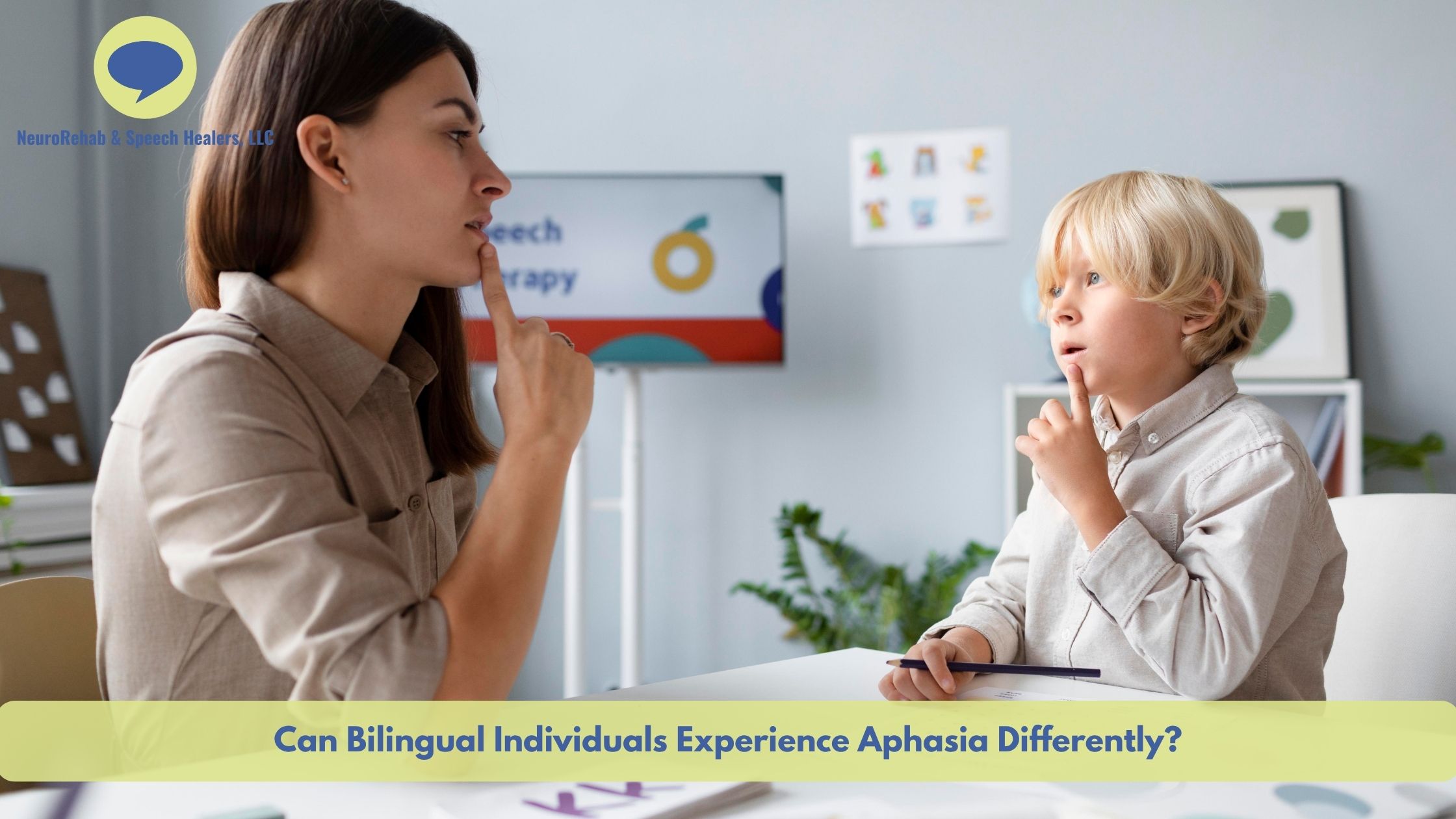
Aphasia is a language disorder caused by stroke or brain injury that affects a person's ability to speak, understand, read, and write. For bilingual individuals, its presentation is rarely straightforward. Impairment doesn't always affect both languages equally, recovery can follow an unpredictable sequence, and standard monolingual assessments often miss the full picture.
Let’s explore the blog and understand what bilingual aphasia is, how it is assessed, what treatment can look like, and what patients and families can expect during recovery.
Bilingual aphasia refers to aphasia occurring in a person who speaks two or more languages, where one or both languages are affected by the underlying brain injury.
The key clinical distinction from monolingual aphasia: brain lesions do not necessarily affect L1 (first/native language) and L2 (second language) to the same degree. Patterns of impairment can differ significantly between languages, with direct implications for assessment, diagnosis, and treatment planning.
This condition is more prevalent than most people realize. The majority of the world's population is bilingual or multilingual, yet most aphasia assessment tools were developed for monolingual English speakers, leaving a meaningful gap in how bilingual patients are evaluated.
When a bilingual person experiences aphasia after a stroke, the impairment can follow one of three patterns:
Pattern | Description | Frequency |
Parallel impairment | Both languages are affected to roughly the same degree | Common |
Differential impairment | One language is more impaired than the other | Most common |
Selective impairment | One language is largely preserved; the other severely impaired | Rare |
Differential impairment is the pattern clinicians encounter most often. Research shows that L1 frequently, though not always, performs better than L2 following a stroke. This is not a universal rule, and exceptions are well documented.
Several factors influence how each language is affected:
The brain does not store each language in a completely separate region. Both L1 and L2 are processed through overlapping neural networks in the language areas of the brain. A single stroke affecting these systems can therefore impact both languages.
Managing two languages requires constant cognitive work: monitoring context, suppressing the language not in use, and switching between systems as needed. Over time, these executive control networks may become more developed.
Some research suggests bilingual patients may show stronger neuroplastic capacity during rehabilitation compared to monolinguals. However, this same complexity makes assessment harder and shows why monolingual tools are often not enough.
Because impairment can appear differently across languages, family members and caregivers may notice signs that do not fit typical aphasia descriptions. These can include:
Accurate assessment is the foundation of effective treatment, and it is where bilingual patients are most often underserved.
Standard aphasia assessments are normed for monolingual English speakers. Used alone, they can underestimate overall language function, misread L2 limitations as impairment, or fail to show which language is most functional for the patient.
A thorough evaluation should assess each language independently and consider:
The Bilingual Aphasia Test (BAT) is a recognized clinical tool developed for this population. It evaluates language across multiple domains in both languages and provides a far more complete picture than a monolingual instrument can offer.
Current evidence supports treating both languages where clinically feasible. Limiting therapy to one language can reduce access to important social, family, and professional relationships. In practice, the SLP prioritizes the language most urgently needed for daily communication, but the other language is not ignored.
A useful finding in bilingual aphasia research is cross-linguistic transfer: gains in one language can carry over to the other, even without direct therapy in both. This is most likely when the languages share similar vocabulary, grammar, or phonological systems.
A common error in bilingual aphasia treatment is translating English-based therapy into another language without adapting the structure. Languages differ in grammar, word order, morphology, and phonology, and therapy should reflect those differences.
There is a shortage of bilingual speech-language pathologists. When one is not available, these options can support care:
These are not replacements for a bilingual clinician, but they can still strengthen a therapy plan.
Recovery timelines in bilingual aphasia depend on stroke severity, age, which languages were affected, and how soon therapy begins. No two recovery paths are identical. A language that seems nearly absent in the first weeks after stroke may return substantially with targeted therapy.
The brain’s neuroplastic capacity is greatest in the weeks and months after injury. Early bilingual speech therapy consistently leads to better outcomes. Delaying treatment can reduce the recovery ceiling for both languages.
Recovery is about more than restoring speech mechanics. Each language carries functional and identity value, and therapy should reflect which relationships, work responsibilities, and daily tasks depend on it.
Bilingual aphasia is not just a language issue. It affects how a person connects with family, work, and everyday life. Because each bilingual patient brings a different language history and a different pattern of use, recovery can look very different from one person to the next.
That is why assessment and therapy need to go beyond a standard monolingual approach. When both languages are considered, treatment becomes more meaningful and more useful in real life.
When aphasia affects a bilingual individual, recovery may look different across each language. At NeuroRehab & Speech Healers, we take the time to understand each patient's language background, communication needs, and everyday goals to help build a personalized path toward meaningful communication after stroke or brain injury.
Contact us today to learn how our speech-language therapy services can help you or your loved one work toward stronger communication and greater confidence throughout the recovery process.
Yes. Selective aphasia, where one language is significantly impaired while the other remains comparatively intact, is documented though relatively rare.
There is no universal pattern. The language that returns first is often the one the patient used most actively before the stroke.
Some research suggests bilingual patients may have greater neuroplastic capacity during recovery, but no broad rule applies to every patient.
Ideally, yes. If a bilingual SLP is unavailable, trained interpreters and structured family support can still help.
The most effective approach treats both languages where possible, adapts therapy to each language, and begins as early as possible post-injury.
Aphasia can severely impair access to the native language, but it is more accurate to describe this as disrupted access rather than erasure.