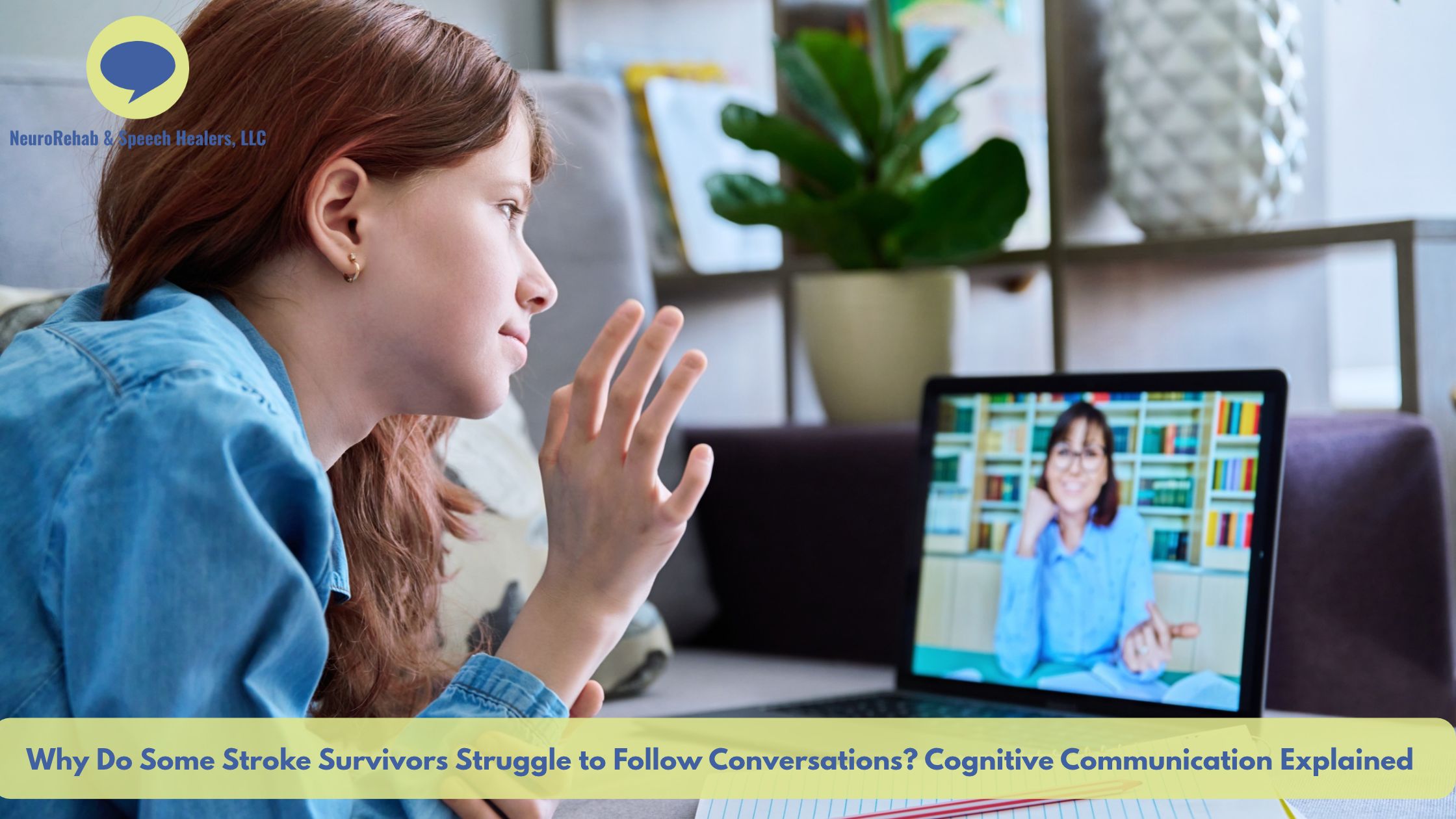
The words are clear. The grammar is fine. The voice sounds just as it always did. And yet a conversation with a stroke survivor can slowly come apart: a question asked twice, a story that drifts away, a topic lost halfway through.
Families often wonder whether this is stress, tiredness, or something deeper. For many survivors, it is a cognitive-communication difficulty, a change in the thinking skills that conversation quietly depends on.
Cognitive communication is the use of attention, memory, organization, and reasoning to take part in conversation. A stroke can disrupt these skills even when the muscles of speech and the language centers are working well.
Following a conversation is a surprisingly demanding mental task. The listener has to focus, hold earlier points in mind, sort what matters from what does not, and reply at the right moment. If any step weakens, the whole exchange suffers.
A speech-language pathologist separates these patterns because each one calls for a different approach.
Pattern | How it sounds | What families notice |
Dysarthria (speech) | Slurred, slow, or quiet, with clear thinking | Words are hard to hear or understand |
Aphasia (language) | Missing, wrong, or jumbled words | Struggles to find or understand words |
Cognitive communication | Clear, fluent words | Loses the thread, forgets, drifts off topic |
These patterns can overlap, which is one reason a full evaluation matters.
Cognitive-communication changes show up in everyday moments more than in formal tests.
Mental fatigue often makes these signs worse as the day goes on. Many survivors describe it as brain fog after stroke, a sense of thinking through a haze.
Attention, memory, and organization depend on networks spread across the brain, not a single spot. Strokes that involve the frontal lobes or the right side of the brain are often linked with changes in planning, attention, and the social side of conversation, such as staying on topic or reading tone.
Memory changes also play a part. A survivor may forget a detailed mid-conversation, which is why memory-focused speech therapy can be a helpful part of recovery.
Stroke also reduces mental energy. Chatting while a television plays, once effortless, can now drain reserves in minutes.
Because the speech sounds normal, people around the survivor often assume recovery is complete. Early rehabilitation tends to focus on walking, swallowing, and clear speech, so subtler changes appear later, when the person goes home, returns to work, or joins a family gathering.
Misreadings are common too. A survivor who loses the thread may be seen as distracted, uninterested, or stubborn, when the real cause is an attention or memory change.
Many survivors sense that something is off, even when they cannot explain it. Conversations that once felt easy now leave them tired, embarrassed, or unsure whether they said the right thing.
Some respond by saying less or avoiding gatherings. Families can easily read that as lost interest. In reality, it is often a way of avoiding the strain of trying to keep up.
A cognitive speech pathology evaluation looks at attention, memory, organization, and everyday conversation, not just words. Therapy is then built around real-life goals, such as following a family dinner, joining work meetings, or handling phone calls.
Stroke speech therapy often combines these cognitive goals with work on speech and language, so one program can cover several needs.
A few adjustments help right away. Talk in a quiet room, one person at a time. Pause often and let the survivor answer without rushing.
Check understanding by asking the survivor to say the main point in their own words, instead of asking "Do you understand?" Brief recaps also help, such as "So we decided to call on Tuesday." For more everyday guidance, see this post on how caregivers can support stroke recovery at home.
Conversation is a thinking skill as much as a speaking one, and stroke can affect it in ways that are easy to miss. Understanding the cause helps families respond with patience instead of frustration.
If a stroke survivor in your family sounds fine but struggles to follow or remember conversations, NeuroRehab & Speech Healers offers online cognitive speech therapy across New York and New Jersey.
Contact us or call (732) 743-8383 to schedule an evaluation with a licensed speech-language pathologist.
It is a recognized effect of stroke and can occur even when speech sounds completely normal.
Many people improve with targeted therapy and practical strategies, though progress varies.
No, stroke-related changes usually begin after a specific event, though a medical team can evaluate any ongoing decline.
When the difficulties persist, affect daily life, or strain work and relationships.
Yes, telehealth sessions can address attention, memory, and conversation skills from home.